
Josephine Release Dates Differ
Four date concepts can appear in a Josephine County case. An ODOC projected release date estimates when prison incarceration should end under the judgment, sentence structure, credits, and expected compliance. A physical release date records when the person actually left a jail or prison. A Board-set parole release date may reflect a separate decision in a case within Board jurisdiction. A discharge date marks the end of legal custody, sentence, or supervision. These dates can be different.
A pretrial detainee is different again. The Josephine County Adult Jail cannot show a sentence-completion date for a person who has not received a sentence. Bail, a release agreement, dismissal, court order, hold, or transfer may end the booking. The jail detail's actual Release Date is an after-the-fact event field. Its Booking From and Booking To search controls refer to booking dates, not projected or actual release dates.
- Projection
- An anticipated date based on the current sentence computation and assumptions.
- Detainer
- A notice that another authority may take custody or require a hold.
- Credit for time served
- Qualifying custody time credited toward the imposed sentence.
- Discharge
- The official end of sentence or supervision authority.
Find Josephine Projected Release Dates
Begin with the custody class. The county jail inquiry, Oregon Offender Search, court system, and federal locators serve different groups. A person whose Josephine booking closed through transfer to ODOC may appear in both county and state records for two separate phases. The county release timestamp ends the jail booking. It does not establish release from the later state term.
- Check the Josephine jail inquiry for a county booking. Leave “In Custody” unchecked to see history, then open the booking and read its disposition, docket, sentence length, and actual Release Date if shown.
- Use the docket number in Oregon court records. Determine whether the person is pretrial, serving a local sentence, on probation, or committed to ODOC.
- For an ODOC term, search the Oregon Offender Search by SID when possible. Match identity, note status and location, and transcribe the current release-date label exactly.
- Save the access date. If the displayed projection changes, compare the judgment, amended orders, credits, and ODOC update rather than relying on an old capture.
- When an official document is needed, request the face sheet, sentence computation, release certificate, or other narrow record from the proper records custodian.
The Josephine County released-inmates page provides the full county release-record path when the goal is to confirm a completed jail release rather than estimate a future date.
Note: A blank or missing result does not prove release; verify identity, custody system, transfer status, and the record source's scope.
Josephine ODOC Release Date Search
Oregon Offender Search, or OOS, is the statewide public source for a person in ODOC custody or under a local Community Corrections office. It is not a county-jail archive. Search by SID for the strongest match, or use the name fields and compare aliases and identity descriptors. The help system allows an asterisk wildcard in name fields, including within a name, while SID does not use that wildcard. Broad searches may require more detail.
| OOS item | How it helps | Limit |
|---|---|---|
| SID | Links to the individual ODOC record | Must match the correct person |
| Status and location | Distinguishes prison from local Community Corrections supervision | Can change after an update |
| Earliest or projected date label | Shows ODOC's current public release calculation | Not proof of actual release |
| Names and aliases | Helps reconcile court and custody identity | A name match alone is not enough |
| Last updated | Gives context for the displayed result | Does not guarantee instant processing |
ODOC communications often use “Projected Release Date,” while the public result may use an “Earliest Release Date” or another current label. Do not rewrite one as the other unless the live record supports it. The official OOS help page explains the current scope and fields shown in the capture below.
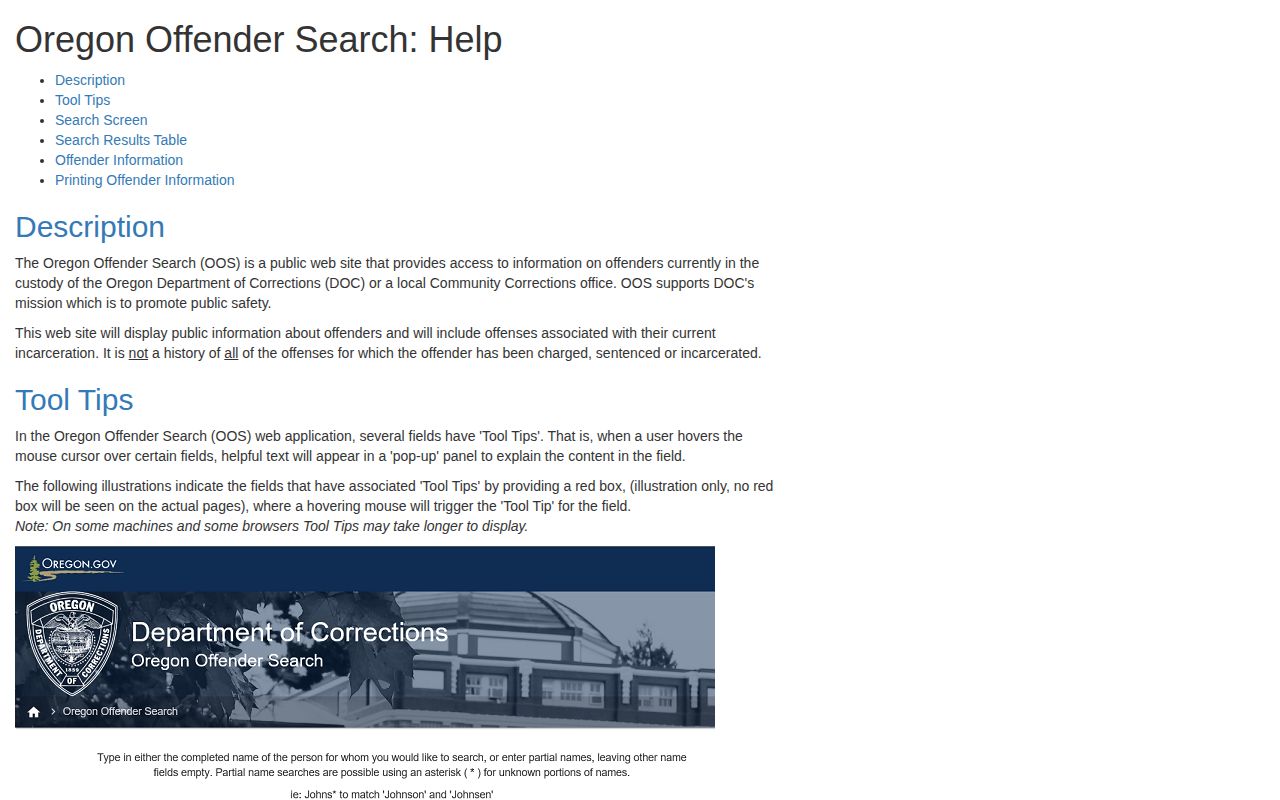
The OOS interface is the public lookup, but its disclaimer means a certified ODOC record remains the proper documentary source when certification matters.
Josephine ODOC Date Calculation
ODOC computes a state term from the signed judgment and related court material under OAR 291-100. The calculation can account for the sentence start, qualifying presentence custody credit, concurrent or consecutive terms, earned-time eligibility and awards, exclusions, sanctions, amended judgments, and authorized forms of transition. ORS 137.370 governs sentence commencement and qualifying credit for custody before sentencing.
Concurrent terms run at the same time to the extent ordered. Consecutive terms run one after another. A court amendment or corrected credit can therefore move the projected release date even when nothing changed in the person's day-to-day custody. Short-Term Transitional Leave may also move an eligible person out of physical prison custody under a separate program before the computed end point. That status does not erase the sentence or amount to full discharge.
ODOC's sentence-recalculation work is a current example of why projections move. A legal interpretation or corrected computation can update OOS. VISOR registrants may receive projected-date changes, but the public result still needs an access date. Old screenshots should never be presented as a live promise.
Oregon Has No 85% Rule
Oregon does not impose one universal 85-percent truth-in-sentencing formula. Under ORS 421.121, an eligible ODOC felony term for a crime committed on or after November 1, 1989 may receive up to a 20-percent reduction for appropriate institutional behavior and adult-basic-skills participation. The law includes conditions and exclusions, and it does not allow the eligible term's actual confinement to fall below six months.
Measure 11 mandatory minimums under ORS 137.700 and other enumerated terms are excluded from that earned-time reduction. Qualifying determinate repeat-felony terms under ORS 137.635 are also served under their own rules. The signed judgment, offense date, conviction statute, and sentence structure must be known before eligibility can be assessed. Simply subtracting 20 percent from a term is not a lawful individual calculation.
This distinction is vital in Josephine County when a jail booking ends with transfer to ODOC. The county booking may carry a release timestamp because the jail closed its custody event, yet the state sentence starts or continues in a different system. ODOC rules control that state computation. The county timestamp does not.
Note: “Up to 20 percent” describes an eligibility ceiling for qualifying ODOC terms, not an automatic award or a county-jail rule.
Josephine County Jail Release Dates
A local Josephine County jail sentence is not calculated with ODOC's 20-percent framework. Oregon county-jail deduction statutes, including ORS 169.110 and 169.120, and local administration govern qualifying deductions for good behavior or work. The sentencing judgment and jail computation control. When the public booking detail has no future date, ask Jail Records or the sentencing court for the computed release information rather than importing an ODOC formula.
Pretrial custody has no sentence-completion date. A court may order release, set or change bail, dismiss a case, or enter a disposition. Separate holds can block physical release even after one case is resolved. A successful bail payment is also not the final release event because processing, other holds, paperwork, property, and transportation steps may remain. The actual jail Release Date confirms when the booking closed after processing.
Custody alternatives need careful labels. Josephine County programs can include work crew, community service, or home detention for some local sentences. A person may be outside the jail building while still in a custodial alternative with enforceable conditions. Report that status from the order or program record. Do not call it full discharge.
Josephine Release Dates Can Change
A projection is based on the facts and law in the agency's current calculation. New or corrected information can move it earlier or later. The reason should be traced to a source record. Avoid guessing from the amount of time served or a prior portal capture.
| Factor | Possible effect | Record to check |
|---|---|---|
| Earned-time review | Eligible credit may be awarded, withheld, or corrected | ODOC computation or face sheet |
| Misconduct or program status | Can affect projected compliance or credit | ODOC record and updated OOS date |
| Presentence credit | A corrected credit can alter the term | Judgment and sentence computation |
| Amended or appellate order | Can change sentence length or structure | Signed court order |
| Consecutive or concurrent correction | Can move the aggregate end date | Judgments and ODOC calculation |
| Detainer or hold | Can prevent community release or cause transfer | Custody-event record and receiving authority |
| Board action | Can set, affirm, defer, postpone, or revoke a parole date | Final Board order |
For applicable guideline sentences, the ODOC final-review process includes an earned-time compliance check near the end of the term and another date check closer to release. Planning requirements and detainers can also affect the physical event. Those reviews explain why a date viewed months before release should be checked again.
Confirm Josephine Physical Release
Use VISOR to request an alert for an Oregon custody or projected-date change when offered. The state system checks source data on a cycle and can notify after processing, so an alert is not a certified release record. Complete the contact verification required by the live email, text, telephone, or account channel. Do not assume that the former four-digit telephone PIN process appears on every current VISOR route.
After an alert, confirm the event at its source. For the Adult Jail, read the booking Release Date and disposition, then seek a JCSO custody-event record if the destination is unclear. For ODOC, compare OOS and request the face sheet, release certificate, or actual physical release record. For parole, obtain the final Board order. For a county or state court issue, use the signed judgment or release order.
A transfer needs one more check. Locate the receiving system before describing the person as released to the community.
The Josephine County VINELink Release Check explains Oregon's current VISOR search and notification route. Federal and immigration custody require separate systems. BOP can show federal release data, while ICE ODLS is a current locator rather than a full release-history archive.
Note: Preserve the displayed label and access time, then confirm whether the event was community release, transfer, supervision, or discharge.